
HARRIER SUNDOWN
The USMC says farewell to the AV-8B Harrier II
Report and photos by George Karavantos
July 19, 2026
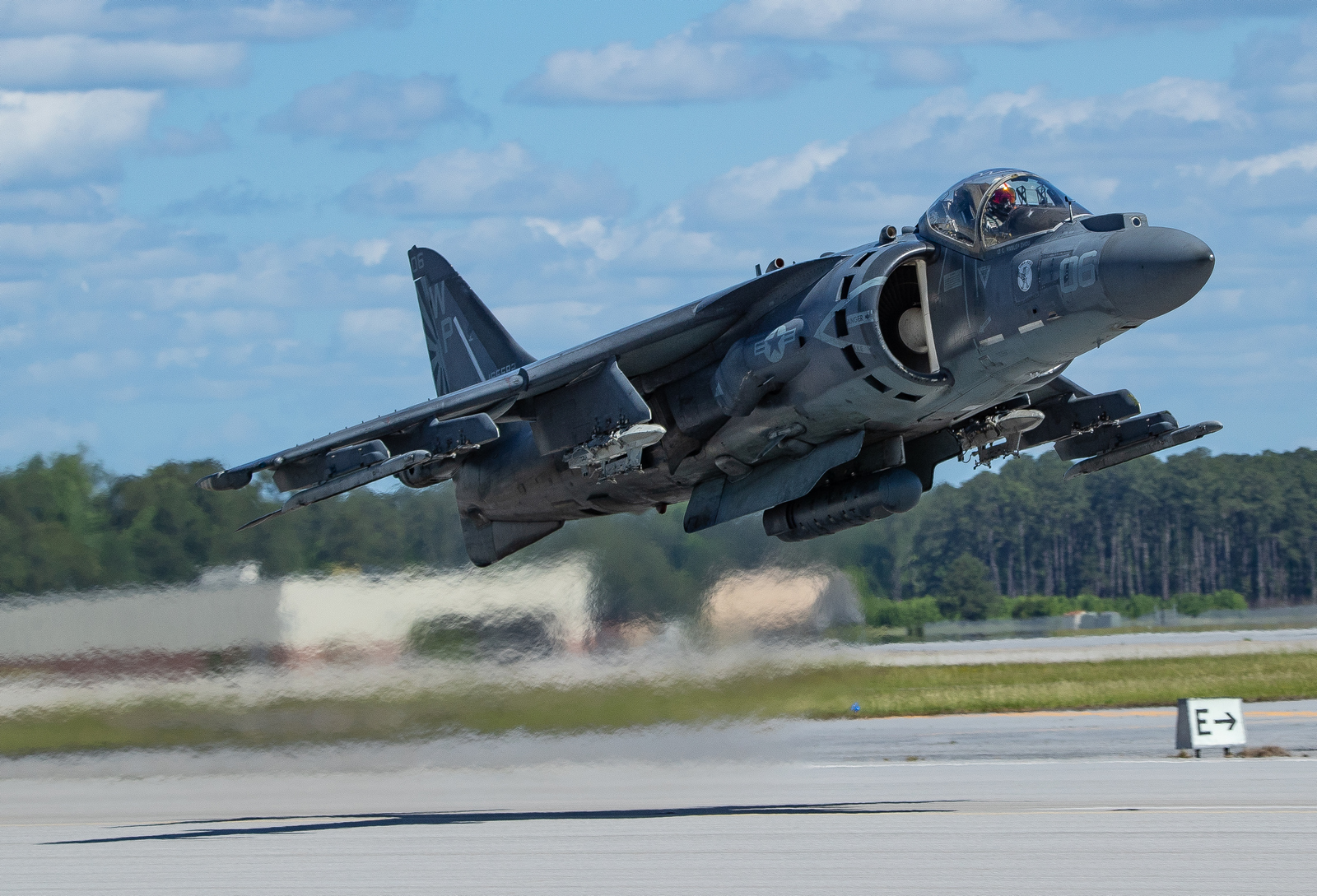
In the twilight of the Harrier’s celebrated career, the US Marine Corps (USMC) had one sole squadron still operating the AV-8B Harrier II. VMA-223’s final flight in the historic aircraft took place on 3 June, marking the end of an era for the venerable Harrier. George Karavantos spent two days at Marine Corps Air Station Cherry Point and offers us a glimpse of this unique aircraft.
The ultimate success of the Harrier for the Marines is significant and undeniable. During the aircraft’s 55-year service starting in 1971 with the AV-8A and concluding in 2026 with the AV-8B, the Harrier fleet has logged more than a million flight hours. Marines have flown combat missions in Kosovo, Afghanistan (OEF), Iraq (OIF), Libya (Odyssey Dawn), and against ISIS (OIR), making the jet one of the most used tactical platforms in the modern era of Marine Corps aviation.
The aircraft provided one-of-a-kind expeditionary close air support from ship decks, roads and forward arming and refueling points (FARPs). The aircraft’s ability to launch and recover with no runway made it ideal for rapid, unpredictable deployments.
“All tactical aircraft should possess a short / vertical take-off and landing capability as soon as it is technically feasible without sacrificing existing mission capabilities”, said Gen Randolph Pate, commandant of the US Marine Corps in 1957.
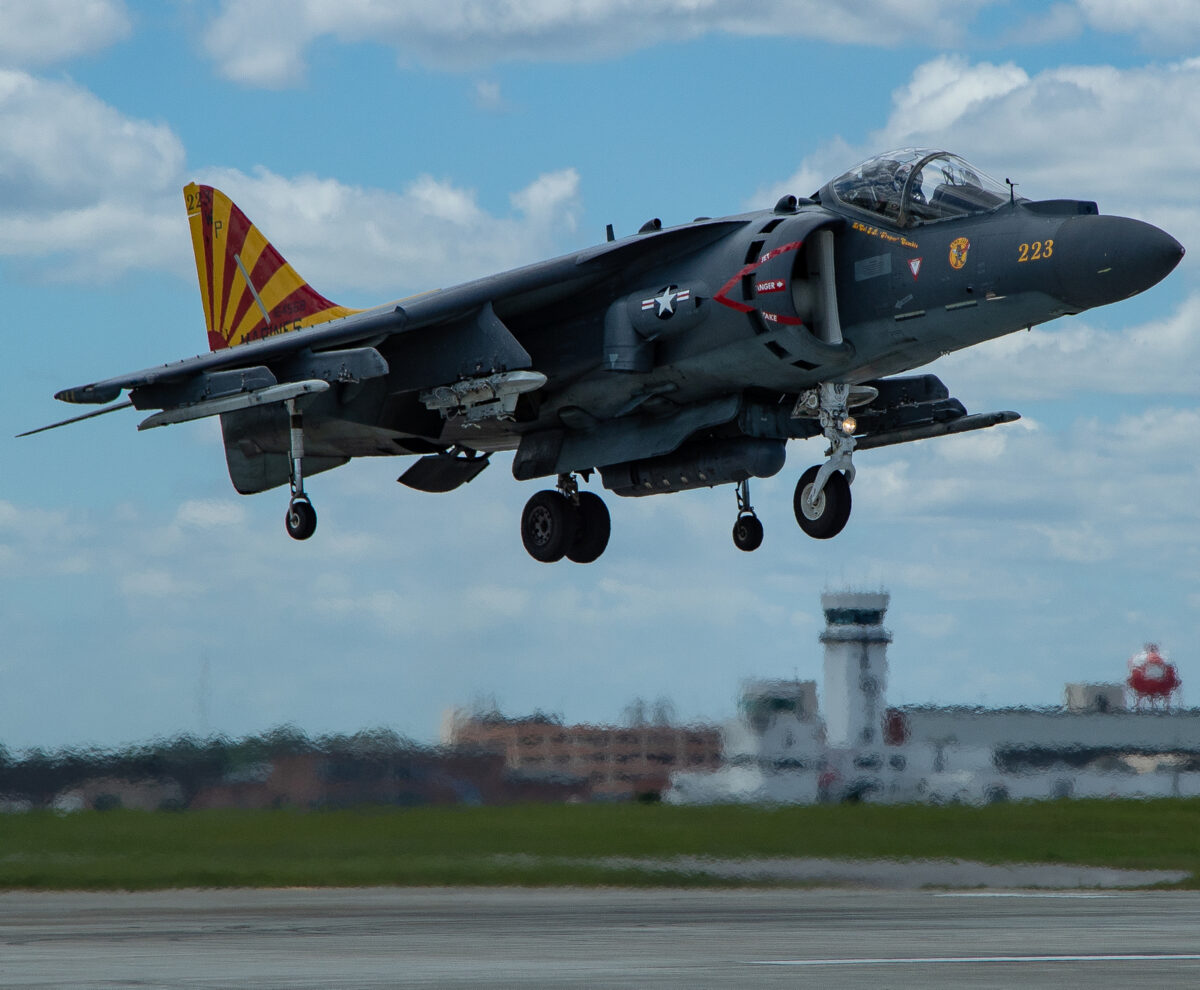
As the F-35B Lightning II has already embarked on its first operational deployments, replacing the Super Hornet / Hornet in Marine Corps service, it appears his vision is finally being implemented. But the first practical steps towards it having been taken in the late 1960s, when the Marines decided to procure the Hawker Siddeley Harrier from Great Britain. Marine Corps interest in a V/STOL tactical aircraft was initially focused on the major Cold War threats of the 1950s: the Soviet Union in Eastern Europe and communist China on the Korean peninsula. As Lt Gen (ret’d) Harry Blot, one of the first AV-8A pilots in the corps recalled: “After Korea, the Marine Corps recognized that air could play a vital part in supporting the ground. The concept of the Marine Air-Ground Task Force (MAGTF) was, and remains, to have a scalable, self-contained, fighting force to provide that first-to-fight capability. A V/STOL tactical aircraft gives land-based and seaborne MAGTFs a fixed-wing capability to be that aerial artillery for the infantry, with the advantage of forward, flexible basing allowing faster response times.”
Vietnam was the first major test of the MAGTF concept, and it identified a few deficiencies in marine aviation. As Blot explained, “Our job was to get there in 10 minutes. In Vietnam, we found that the average time from a call for help to bombs on target was 27 minutes. It wasn’t the fault of the Air Force – the pilots were doing everything they could. It was that we had conventional airplanes and there were only a few airfields that we could operate from.”
An aircraft that could fly from shorter runways, (if any runway at all), would have lessened the response time to calls for close air support (CAS). Blot summarizes, “The Harrier actually turned out to be the first V/STOL airplane that was operationally effective.”
Evolution to Plus:
The AV-8B Harrier II originated from the British Hawker Siddeley Harrier, a vertical / short take-off and landing (V/STOL) aircraft first flown in 1967 and introduced into Royal Air Force service in 1969, with the U.S. Marine Corps adopting the AV-8A variant in January 1971. In the mid-1970s, McDonnell Douglas and British Aerospace initiated development of a substantially redesigned aircraft to improve payload, range, and avionics. The YAV-8B first flew in St. Louis on November 9, 1978, followed by the first production AV-8B on November 5, 1981. It entered operational service with the US Marine Corps in August 1985 when VMA-231 achieved initial operational capability (IOC).
The redesign included a new wing, structural changes, and updated systems rather than incremental modification of the AV-8A. A two-seat trainer version, the TAV-8B, first flew in 1986.
The Harrier II eventually replaced both the A-4M Skyhawk and AV-8A Harrier in USMC service and, at its peak, was flown by eight operational squadrons and a Fleet Readiness Squadron (FRS). The Marines accepted the last of 259 AV-8Bs and 22 TAV-8Bs in September 2003. U.S. production reached 280 aircraft plus attrition replacements, contributing to a total second-generation Harrier production of 433 aircraft across U.S., British, Spanish, and Italian programs.
The AV-8B design incorporated a supercritical composite wing with 14.5% greater surface area and 20% greater span than the AV-8A, enabling increased fuel and ordnance carriage. The airframe used extensive carbon fiber composites to reduce structural weight and increase fatigue life. The propulsion system consists of a single Rolls-Royce Pegasus turbofan with four swiveling exhaust nozzles on the fuselage that vector thrust for vertical or short takeoff and landing operations, supported by reaction control valves for low-speed attitude control. The cockpit was redesigned with improved visibility and hands-on-throttle-and-stick controls, and later variants integrated forward-looking infrared sensors and compatibility with night vision equipment.
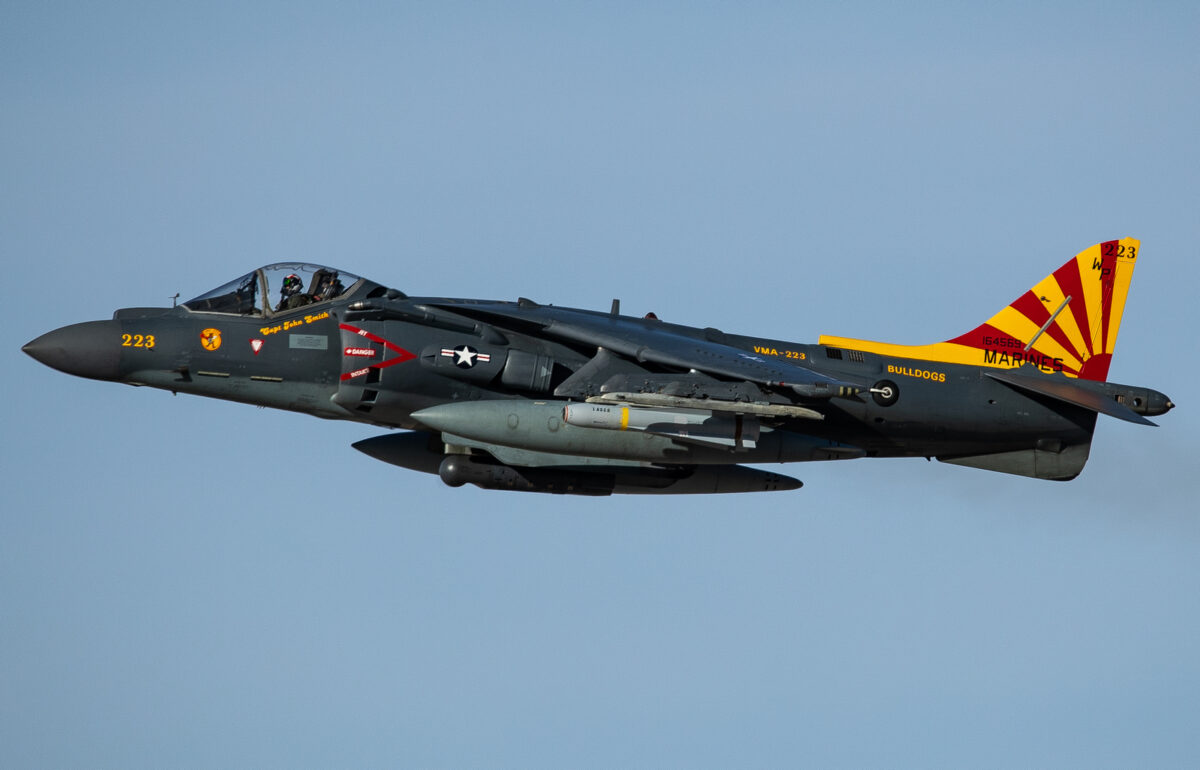
Originally deployed as a day-attack platform, the “night-attack” variant of the AV-8B, introduced from the 167th airframe onward, first flew in June 1987 and entered service in September 1989. It featured a GEC-Marconi forward-looking infrared (FLIR) navigation system installed above the nose, a new night-vision goggles (NVG)-compatible wide-angle head-up display (HUD) and color head-down displays in the cockpit along with a color digital moving map. The jet also incorporated aerodynamic modifications, a 23,400lb st (104.1kN) Rolls-Royce F402-RR-408 engine and four AN/ALE-39 chaff/flare dispensers on the top of the aft fuselage. Sixty-six production aircraft were delivered. The Marines received 101 production aircraft – 27 new-builds and 74 earlier day-attack AV-8Bs converted to the latest configuration – with VMA-223 taking on its first AV-8B (NA) in September 1989.
Development of the radar-equipped AV-8B+ began in 1990 and the first production aircraft flew in March 1993. The AV-8B+, equipped with the same radar used on the F/A-18C Hornet, made its first flight on September 22, 1992. The U.S. Marine Corps received its first Harrier II Plus in 1993 and its first remanufactured aircraft in 1996.
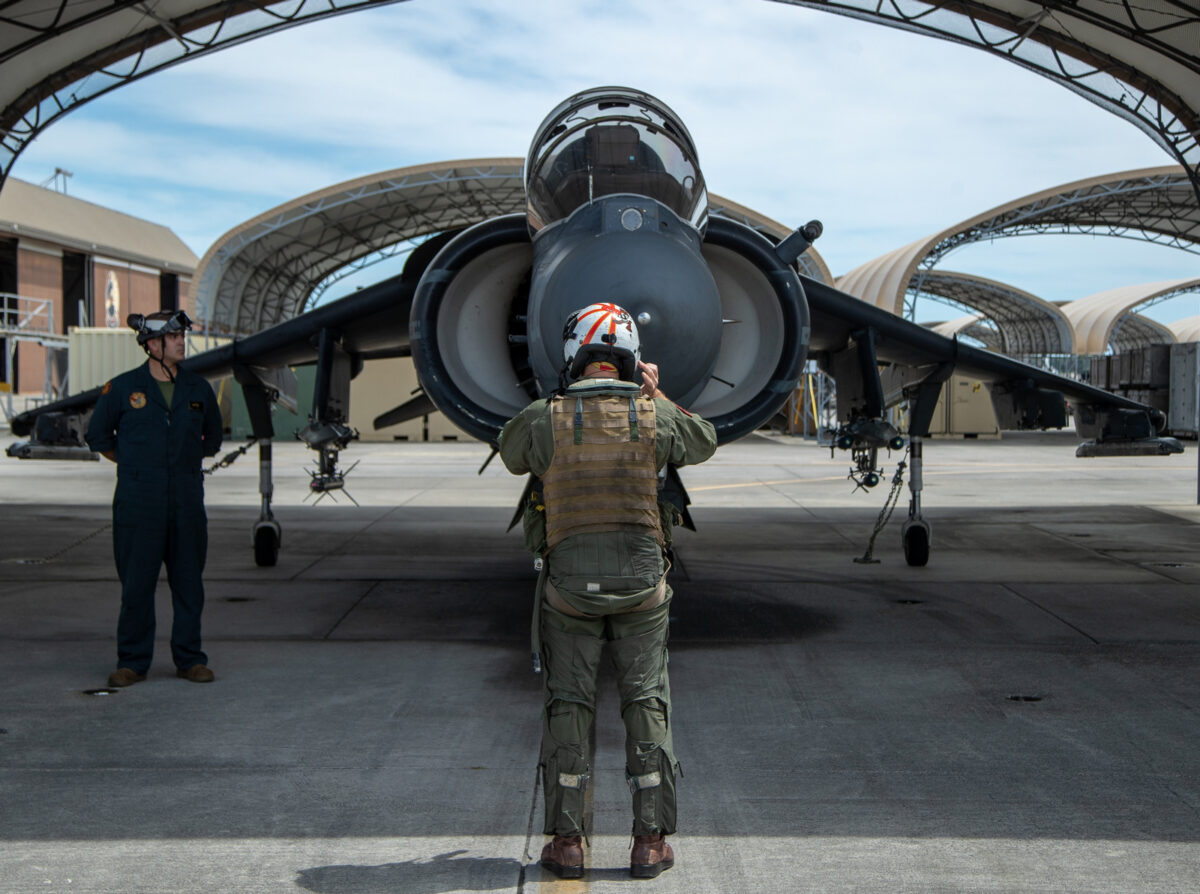
The AV-8B Plus added the AN/APG-65 radar housed in a forward radome, enabling employment of radar-guided air-to-air and anti-ship weapons. Structural modifications included a 17in (0.43m) fuselage stretch and a larger, thicker leading-edge root extension (LERX) which increased the aircraft’s turn rate. Other new features included a new night vision goggle compatible cockpit, Mil-Std-1760 wiring, NAVFLIR incorporation and a digital moving map. The aircraft mounted a GAU-12 Equalizer 25 mm rotary cannon with 300 rounds in a ventral pod and supports up to six underwing pylons for mixed ordnance configurations. Compatible weapons have included AIM-9 Sidewinder, AIM-120 AMRAAM on radar-equipped variants, AGM-65 Maverick, AGM-84 Harpoon, AGM-88 HARM, Mark 80 series bombs, Paveway laser-guided bombs, and Joint Direct Attack Munitions. In total, 51 new and 68 remanufactured AV-8B Harrier II Plus aircraft were delivered.
Operators of the AV-8B Harrier II have included the Spanish Navy, the Italian Navy, and the United Kingdom through British-built GR.5, GR.7, GR.9, and T.6 variants, with British service ending in 2010 and most aircraft sold to the United States for spare parts recovery. Spain plans to retain its Harriers until 2028, while Italy is already transitioning to the F-35B.
Operations:
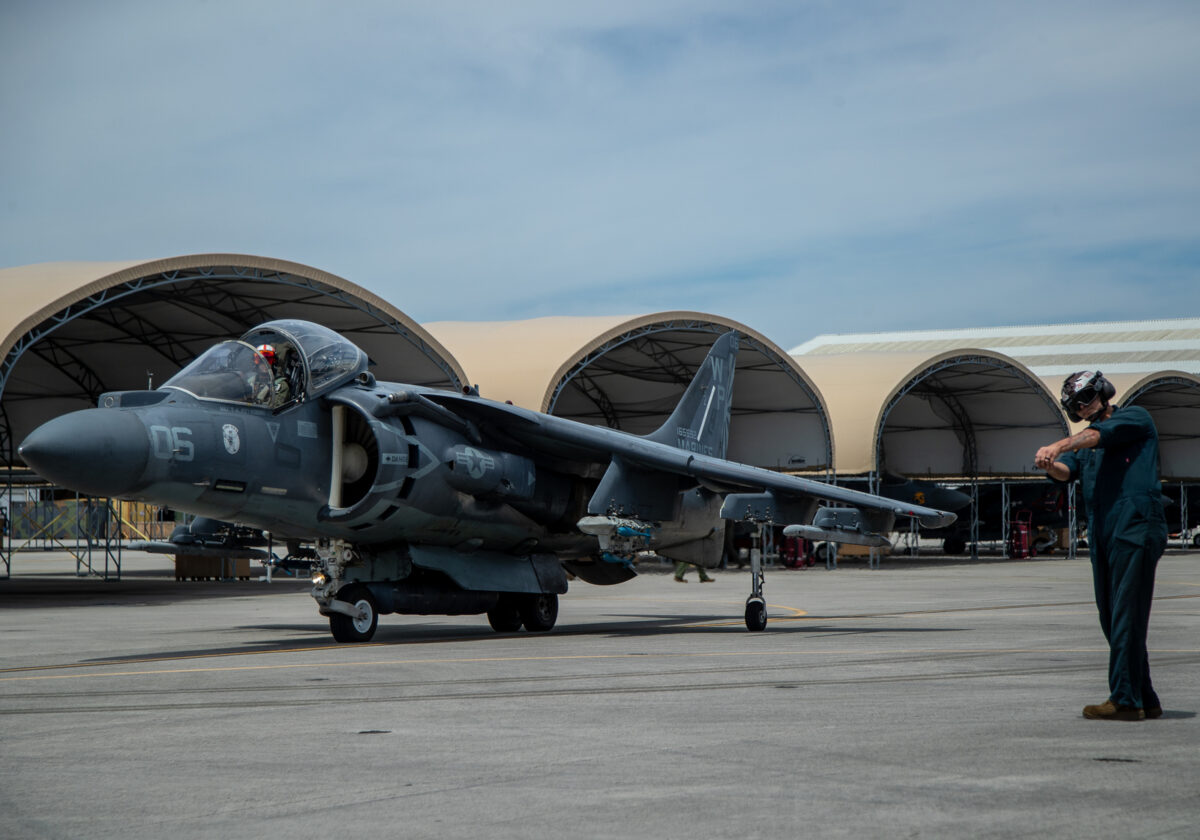
Operationally, with the U.S. Marine Corps, the AV-8B participated in Operation Desert Shield and Operation Desert Storm in 1991, flying 3,380 sorties totaling 4,083 flight hours with mission capable rates above 90%, operating from expeditionary airfields and amphibious assault ships, and basing as close as 35 nautical miles from the Kuwait border with average surge turnaround times of 23 minutes.
The aircraft subsequently operated in Kosovo, Afghanistan, Iraq, Libya, Syria, and the Red Sea region, supporting operations including Enduring Freedom, Iraqi Freedom, Inherent Resolve, Resolute Support, and Southern Spear. Missions included close air support, armed reconnaissance, helicopter escort, air defense, and maritime strike while embarked aboard amphibious assault ships as part of Marine Expeditionary Units. As VMA-223 completed the final deployment and the fleet will transition fully to the F-35B, the AV-8B concluded more than five decades of U.S. Marine Corps fixed-wing vertical and short takeoff combat operations.
Bulldogs:
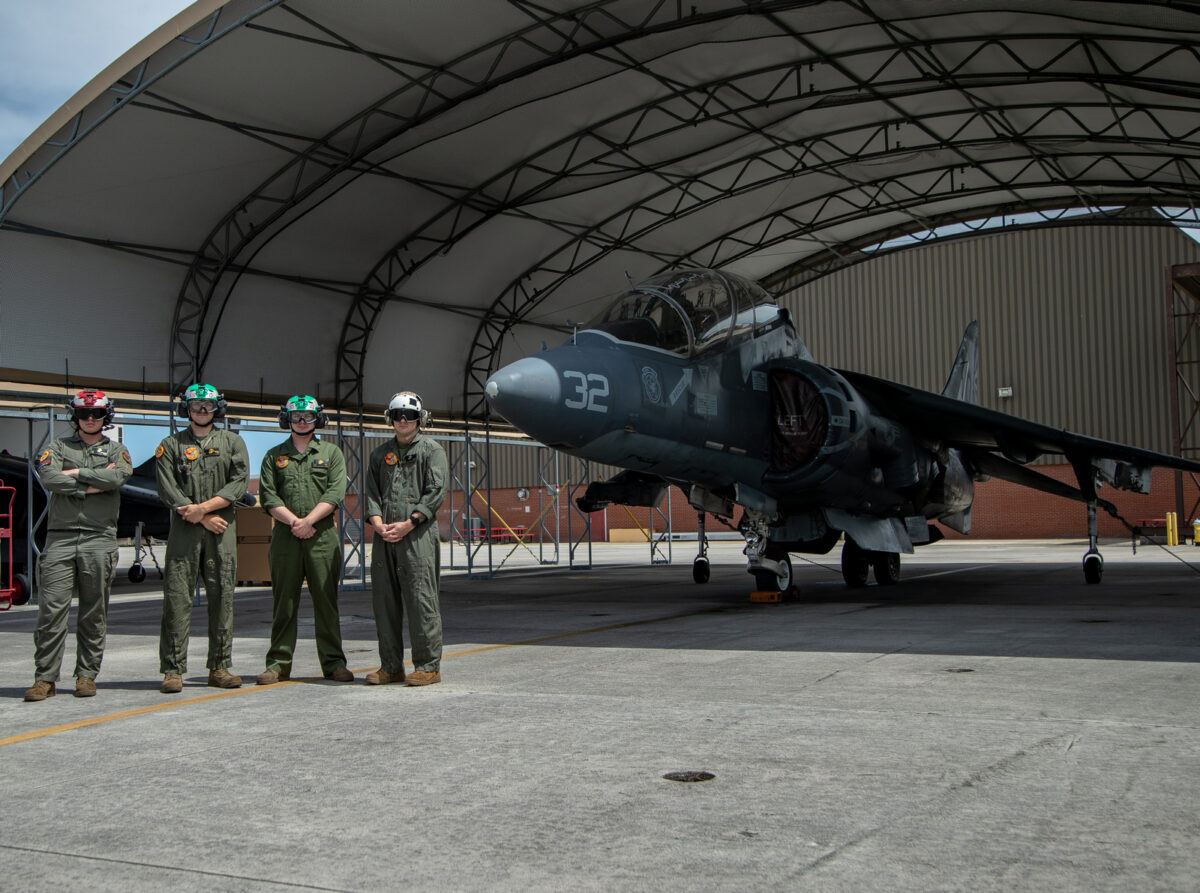
The ‘Bulldogs’ was originally activated as Marine Fighter Squadron VMF-223 ‘Rainbow’ under MAG-23 at MCAS Ewa, Oahu, Hawaii, on May 1, 1942, flying the Brewster F2A-3 Buffalo.
It had transitioned to the Grumman F4F-4 Wildcat before it first saw combat in August that year during the Battle for Guadalcanal, and destroyed 83 Japanese aircraft in less than two months. It then flew a succession of types before adopting the Harrier.
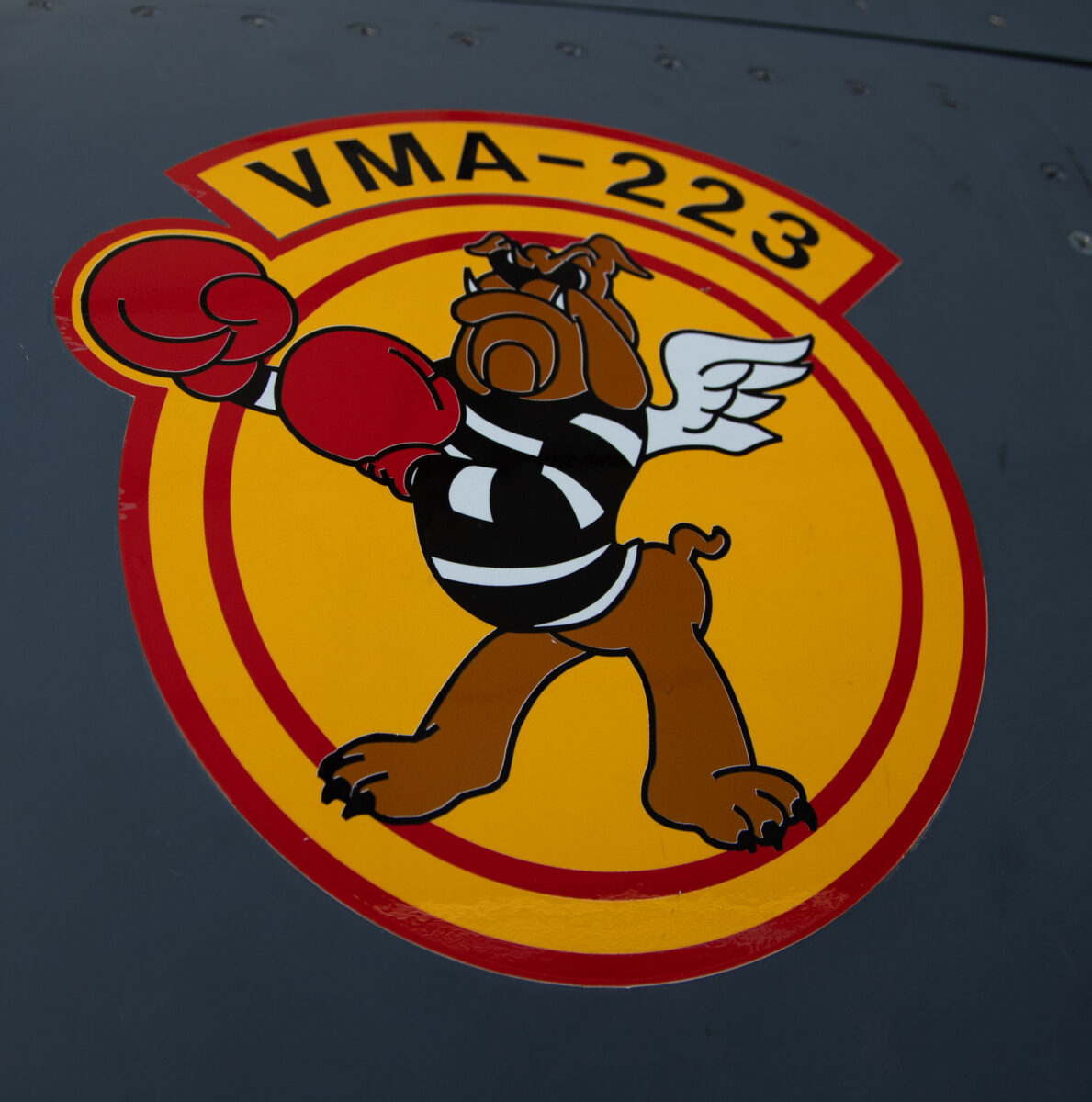
Stationed at Cherry Point and assigned to MAG-14 since relocating from MCAS Iwakuni, Japan, in August 1977, VMA-223 has operated the Harrier II since its transition from the Douglas A-4M Skyhawk began in October 1987. The ‘Bulldogs’ had operated the Skyhawk in various versions since 1961 and had made several combat deployments to Southeast Asia between 1965 and 1969. The squadron received its current identity as a Marine Attack Squadron (VMA) on December 1, 1954.
Since 2001, VMA-223 has conducted multiple deployments to the US Central Command (USCENTCOM) area of responsibility and supported combat operations in Afghanistan, Iraq and Syria.
As well as full and partial squadron deployments to land bases, VMA-223 participated in Marine Expeditionary Unit (MEU) embarkations aboard many US Navy amphibious assault ships.
AV-8Bs from VMA-223 flew combat missions over Afghanistan during the earliest phases of Operation Enduring Freedom. Detached to HMM-365 (Rein.) aboard the USS Bataan (LHD 5) as part of the 26th MEU, Detachment A flew its first strikes against the Taliban on November 21, 2001, the first time the squadron had seen combat since 1969.
In January 2003, the ‘Bulldogs’ deployed ten Harrier IIs aboard the USS Kearsarge (LHD 3). Following its arrival in the Northern Persian Gulf, the squadron moved to the Bataan. A combined force of 26 AV-8Bs, made up of VMA-223 and VMA-542, operated from the ship, and together flew 1,400 combat hours during 797 sorties starting in early March in support of the invasion of Iraq.
The unit’s most recent ship-based deployment involved six AV-8Bs as part of the 22nd Marine Expeditionary Unit (Special Operations Capable), conducting operations aboard the Wasp-class amphibious assault USS Iwo Jima (LHD 7). The jets returned home only a few days before the retirement ceremony proving in the best way that the type remained operational until the very end.
Ground personnel from the Harrier community will be transitioning primarily to the F-35B Lightning II, as by the end of 2026, the Marine Corps plans to field 205 F-35B and 56 F-35C aircraft within a total program of record of 420 F-35s. But most of the pilots who are senior with more than 10-15 years of experience and many hours on the type plus combat missions will not continue to the F-35B!
MCAS Cherry Point:
MCAS Cherry Point is located in Havelock, North Carolina, United States, in the eastern part of the state. It was built in 1941, and was commissioned in 1942 and is currently home to the 2nd Marine Aircraft Wing. MCAS Cherry Point was home to more than 80 Harrier IIs assigned to the 2nd Marine Aircraft Wing (MAW). In 2024, VMFA-251 received their first Joint Strike Fighter aircraft, making it the first active duty F-35C Lightning II squadron on the East Coast.
Apart from the Harriers and their last operating squadron, MCAS Cherry Point is also the home base of the following fixed wing squadrons:
- Marine Fighter Attack Squadron VMFA-251 ‘Thunderbolts’ which operates the F-35C Lightning II.
- Marine Fighter Attack Squadron VMFA-542 “Tigers’, also an ex-Harrier squadron which now operates the F-35B Lightning II.
- Marine Fighter Attack Squadron VMFA-231 ‘Ace of Spades’, also an ex-Harrier squadron which now transitioning to/operating F-35B Lightning II.
- Marine Aerial Refueler Transport Squadron VMGR-252 ‘Otis’ with KC-130J Hercules tanker/transport aircraft.
- Marine Unmanned Aerial Vehicle Squadron VMUT-2 ‘Night Owls’ with RQ-21A Blackjack and MQ-9A Reaper unmanned aircraft.
These units are part of the 2nd Marine Aircraft Wing, under Marine Aircraft Group 14 (MAG-14).
Interview:
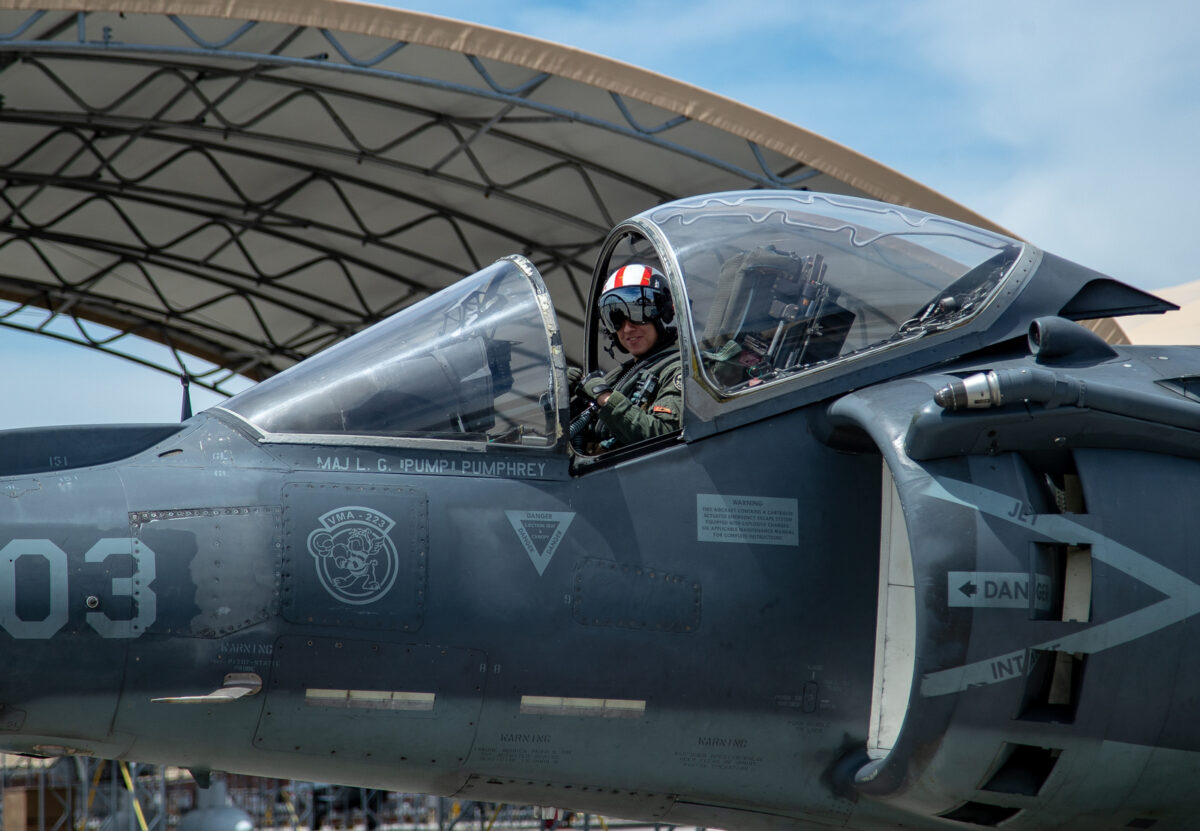
We had the opportunity to interview three key members of the Bulldogs’ community and discuss with them the challenges of operating the Harrier until the end. These were:
1) Staff Sergeant Kyle Meattey, Quality Assurance Officer, Quality Assurance Chief.
-What are the challenges of maintaining an old aircraft like the Harrier?
“So, the last five years, we’ve seen a hard time getting spare parts. We’ve seen the supply system dwindle because they stopped making the equipment or the components we needed. So that made it challenging. From when I first came in, we were getting parts in a couple hours; nowadays we’re waiting a couple weeks. Those are some big challenges we’ve seen, is really just maintaining our supply system.”
– Is it also challenging the maintenance of an old aircraft in terms of troubleshooting? Would you prefer a new aircraft instead?
“Everyone has their preferences, so me personally, I like it. It’s more of a challenge, especially troubleshooting. You get the aircraft coming back from flight, it’s broken. You actually have to dig into the webs. You’re shooting every wire; you’re running every single test. You’re creating new tests, trying to diagnose what the issue is. Everyone is putting their minds together, trying to figure out what’s wrong!”
-Is it more straight-forward dealing with those malfunctions of an old aircraft instead of dealing with many electronic failures of the more computerized aircraft?
“Yes and no. Cause again, at this point in age, this aircraft’s 40 years into service, where you’ll be going through and you find a wire route that was bad from 10 years ago, and it finally actually went bad. So now, we actually have to chase that whole wire, remove the wing, remove the engine, redo that wire route, and then find a solution. And that’s three weeks into the process. But again, for me, personally, I love it. I love actually having to troubleshoot and break it down. That’s not a knock to the F35 because their system’s awesome. I mean, you have a jet coming back from flight; it tells you what’s wrong and orders the parts already.”
-Has Pegasus been a reliable engine? Did it create a lot of problems during its service?
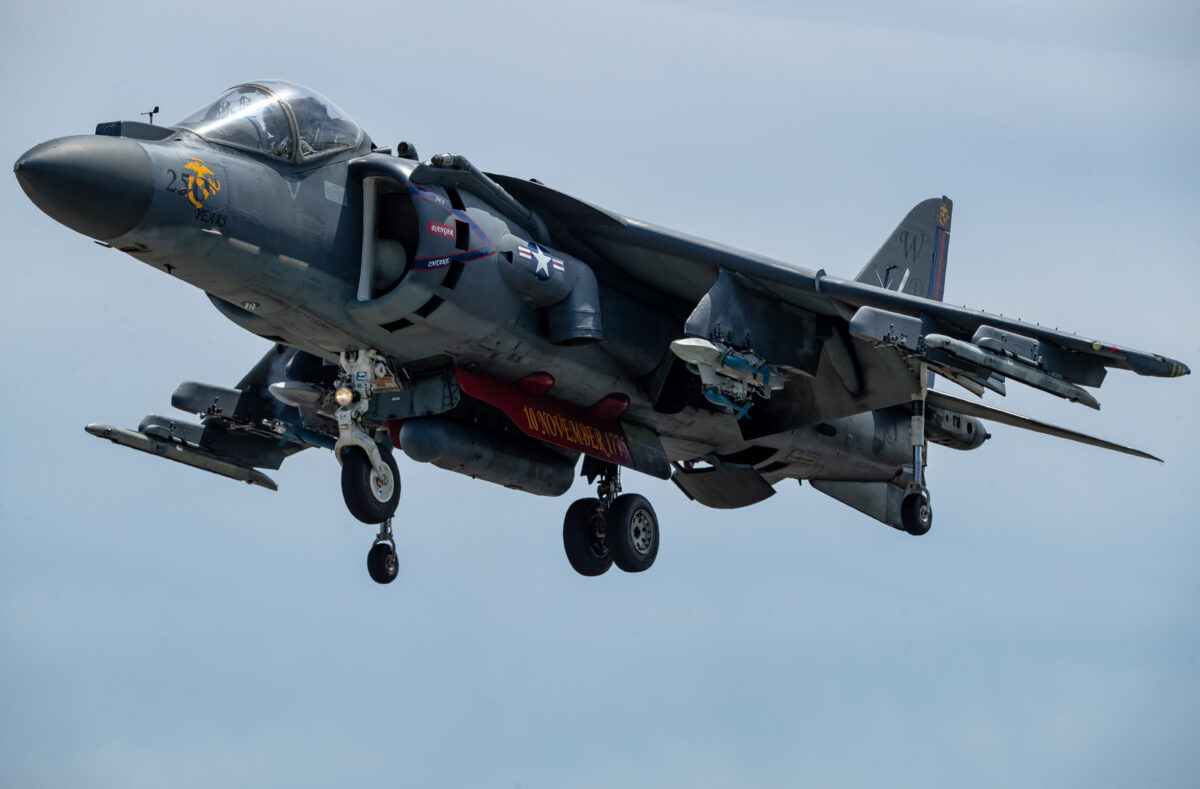
“It’s not completely my specialty, but I’ve worked a lot with the engine being in quality assurance, because, we do the entire engine monitoring and we do all the testing and everything like that. For me, no, I haven’t seen any issues with the Pegasus, the 402 that we have, I think it’s a phenomenal engine. The only thing is that it’s susceptible to FOD. But that’s just our aircraft design with how low it is.”
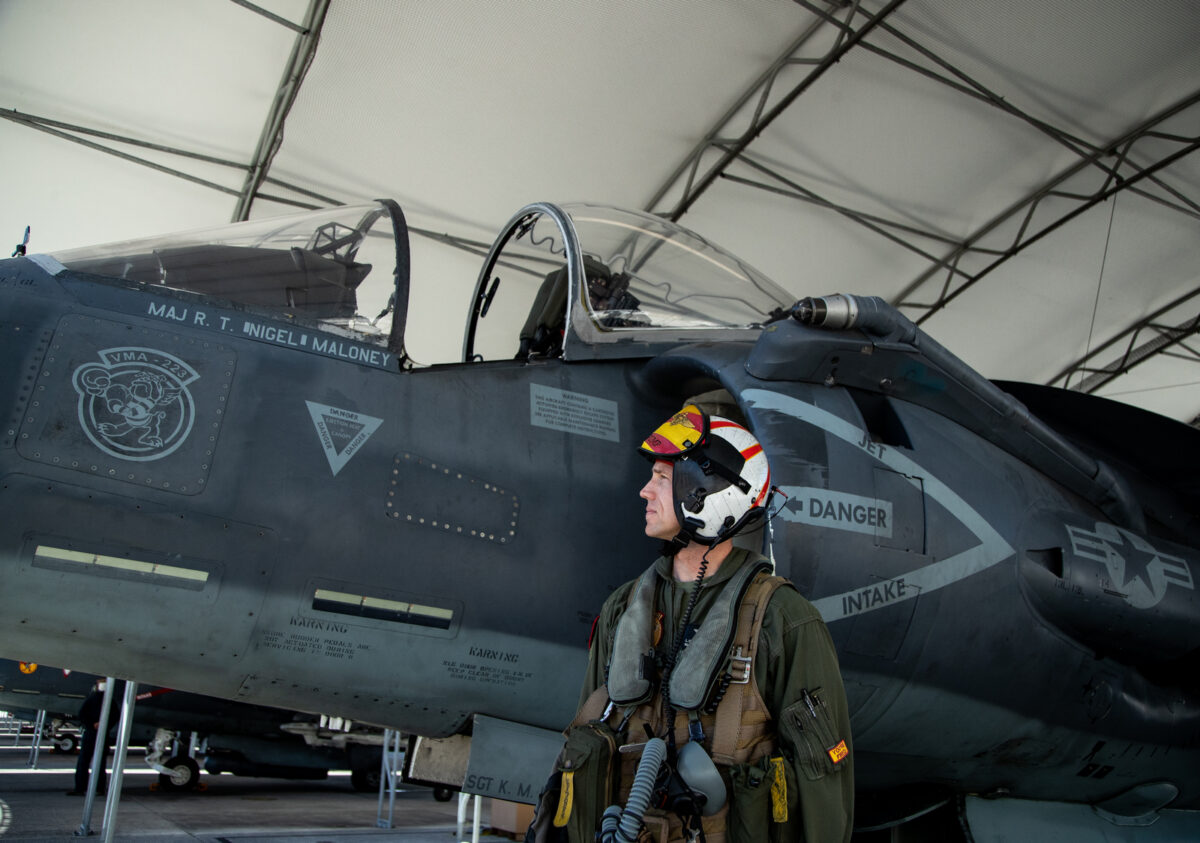
2) Our next interviewer was Major Trevor Robbins, instructor pilot of the Harrier and Operations Officer of the VMA-223:
-What are the advantages and disadvantages of flying an older aircraft? Is it demanding to fly the Harrier?
“As far as the advantages, when you kind of transition into the hover, that is super, different than anything else that you’ve ever experienced before in aviation. That is awesome! Things that you would consider a disadvantage that I kind of like would be the fact that there is no fly-by-wire control system. So it’s just you and a set of hydraulic actuators. The Harrier will not do anything that you don’t tell it to do. If I don’t do it, it doesn’t happen. If I do something wrong, I mean you’ll get some warnings for sure, but it will not autocorrect or do anything for you. Do I consider that a disadvantage? No. I think that’s actually great. Airplanes are not trying to outthink me. I don’t want them to.
But that also raises your workload in the cockpit. And that’s one of the things that they intentionally designed the F-35 is that they wanted to reduce pilot workload so that they could have more opportunity to operate the systems.”
-How do you actually calculate and perform your takeoffs depending on the weight and loads? And how do you fly and especially land the aircraft?
“You have a computer in there that, based on the environmental, the overall weight of the aircraft: fuel and payload, calculates a rotation speed and also an angle of your nozzles. So we use the nozzles to assist our takeoff. We call it the “short takeoff”. And then as you continue to accelerate, the nozzles go further and further aft, until they are basically all the way back and flying like a normal airplane. And then you’re totally depending on the wing. You’re like a normal airplane. That’s the transition out of what we call jetborne to semiborne into wingborne.
Until we come back in. As we come on the way back in, we’ll come wingborne, semi jetborne, fully jetborne as that transition happens in reverse.
As we’re on the way in, we’re slowing down, slowing down. And then we start to bring the nozzles back down. And we kind of gradually work them all the way until they’re straight down. As you slow down, you’re becoming less and less depending on the wing. And usually we consider about 50 knots to be the transition point where you’re slow enough that the wing is now creating zero lift. And also your aerodynamic controls are completely ineffective. So that’s why you have to be at a certain weight, because the engine should entirely support the weight of the aircraft when the wings are creating no lift. And what we use there is the reaction controls: So we’ve got the one on the nose, one on each wingtip and one on the tail. Those controls operate exactly the same way like in a space shuttle that orients itself out in space. But they’re slow! Every movement is much slower and more deliberate when you’re in the hover. Also the reaction controls use engine bleed air. So every time you make a control input while you’re in the hover, you are taking thrust away from the engine.
And then with the power, you’re functionally controlling your altitude at that point.: so less power, less altitude.”
-What is the legacy that the Harrier is leaving behind?
“It’s a close air support airplane. It has worked, in very close, relationship with all the ground forces. The Marines, the Army, the Air Force, anybody that was on the ground, who had been in need of the Harriers overhead.
Like the A-10, it has flown in close proximity to American and other global forces on the ground that were getting shot at and saved the day! That is 100% the legacy of the Harrier.”
3) Our last interviewer was Major Eric Scheibe, the Executive Officer of VMA-223.
-Tell us about the VMA-223 sundown ceremony?
“So the ceremony, as we’ve been planning it, we realized that, this is a pretty big thing for all the Harrier community – for those who flew it and worked on it: Civilian contractors, corporate industry partners and international partners. I mean it’s huge for 50 plus years. So, one of the things that we looked at the squadron level was making sure we were inclusive of all of those entities. So one of the things you’ll see is that it doesn’t say 223’s sundown, it says Harrier’s sundown. And that’s what we want to project out. We want everybody that’s interested, in the Harrier program, had a hand in it or just loved the aircraft, to be able to celebrate with us. So we have set this up for a full week of activities. We got the local community involved. So a lot of the townships, here are going to host, social events on different nights. So that’ll be nice, open to the public, let everybody get together, see all their old friends, all their old squadron mates, and hang out.
The official, events will happen on Wednesday (3 June) here at MCAS Cherry Point. So we’ll have a start at “ten hundred”. We’ll have a small ceremony in front of the flight line there. The aircraft will take off. We’ll join up and we’ll conduct a formation flyover. And then we’ll come in for the break overhead. And then the plan right now is for everybody to do one last vertical landing. Once we’re done with that, we’ll taxi in front of the crowd and we’ll shut down our engines for our last time.”
-What does the Harrier mean to your community or to the people who were involved with it?
“The Harrier, I would say, is a consistent aircraft. It’s going to provide what it provides, for the forces on the ground. You hear the call signs checking in and you know that we’re there to support. I commonly say, I’m just the guy that gets to operate the aircraft, but there are hundreds of people prior to me, that get to execute all of their hard work.
So, when you think about the Harrier, you think about the community, you think about the legacy. It’s full of professionals: people that love this aircraft, they love the uniqueness of it, they love the difficulty of it. The pilots love it because it’s hard to fly. Maintainers love it (sometimes), because it’s hard to work on it. But they take pride in that. They take pride in the fact that it’s not as easy as other aircraft. So I think that breeds kind of this culture of professionalism, where everybody’s working towards this common goal of getting that aircraft off the line, airborne, to support people on the ground. We all got to work together, to make this happen.”
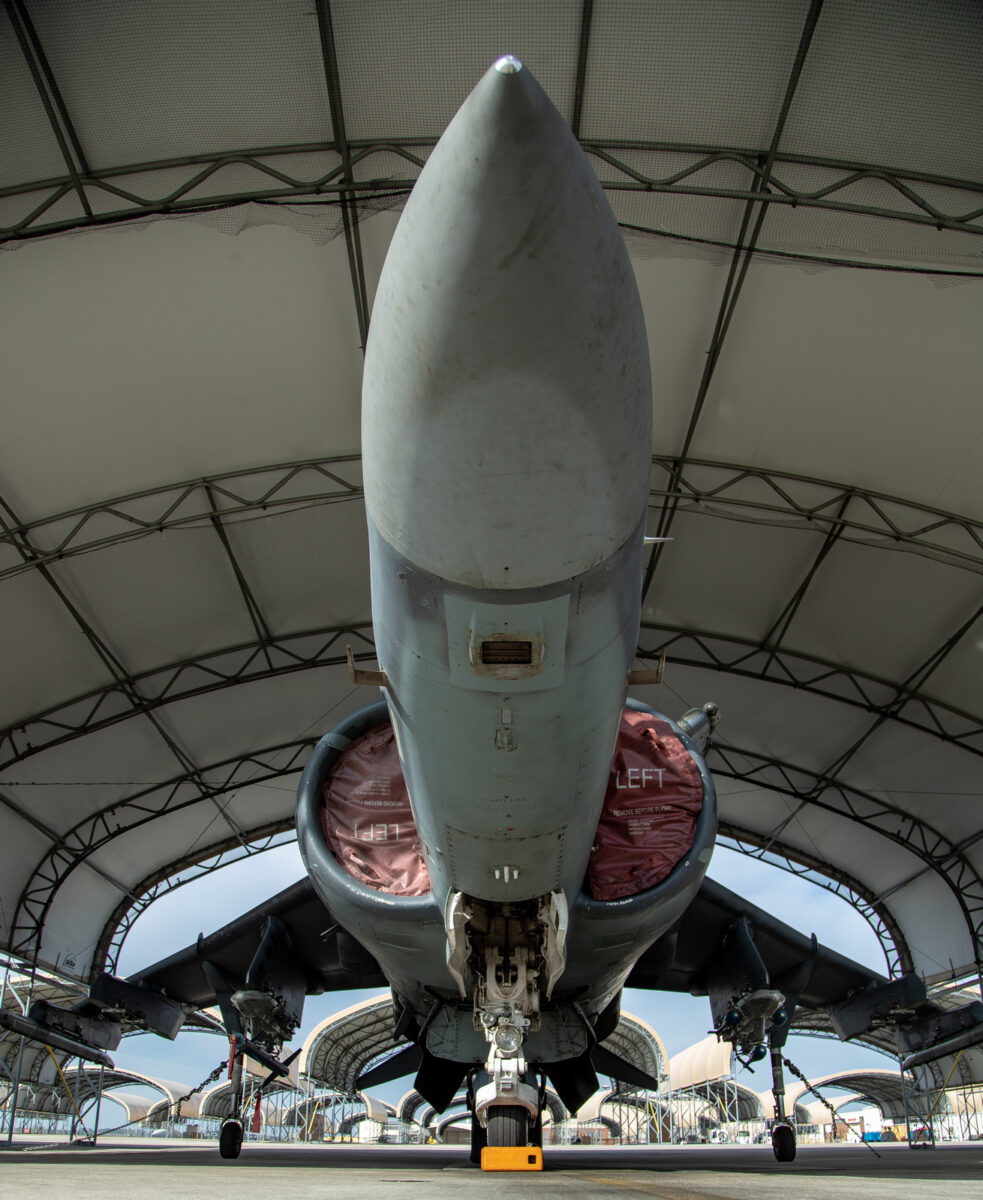
MARINES’ HARRIER SQUADRONS:
The Marine Corps had several squadrons that operated the AV-8B Harrier over the years:
VMA-211 (1990-2016. Converted to F-35B)
VMA-214 (1989-2022. Converted to F-35B)
VMA-223 (1987-present. To convert to F-35B in 2026)
VMA-231 (1985-2025. To convert to F-35B in 2026)
VMA-311 (1988-2020. Converted to F-35C)
VMA-513 (1944-2013. Reactivated as VMFAT-502 in 2020. Converted to F-35B)
VMA-542 (1986-2022. Converted to F-35B)
VMAT-203 (1983-2021. Former Harrier Fleet Replacement Squadron (FRS))
VX-31 commonly referred to by its nickname, “The Dust Devils”, is a United States Navy air test and evaluation squadron based at Naval Air Weapons Station China Lake, California. In 2025, the squadron retired its AV-8Bs II from service, marking the last use of the jet from the Navy.


George Karavantos is from Athens, Greece. His love with military aviation started at the age of 10 when he accidentally read a Greek aviation magazine. Since then, he never stopped reading about fighter aircraft and taking photos of them. He was too tall to become a fighter pilot, so he became an airline pilot. Nowadays he is a Captain and a Flight Instructor on the A320 aircraft. Despite his profession, military aviation will always be his obsession.