
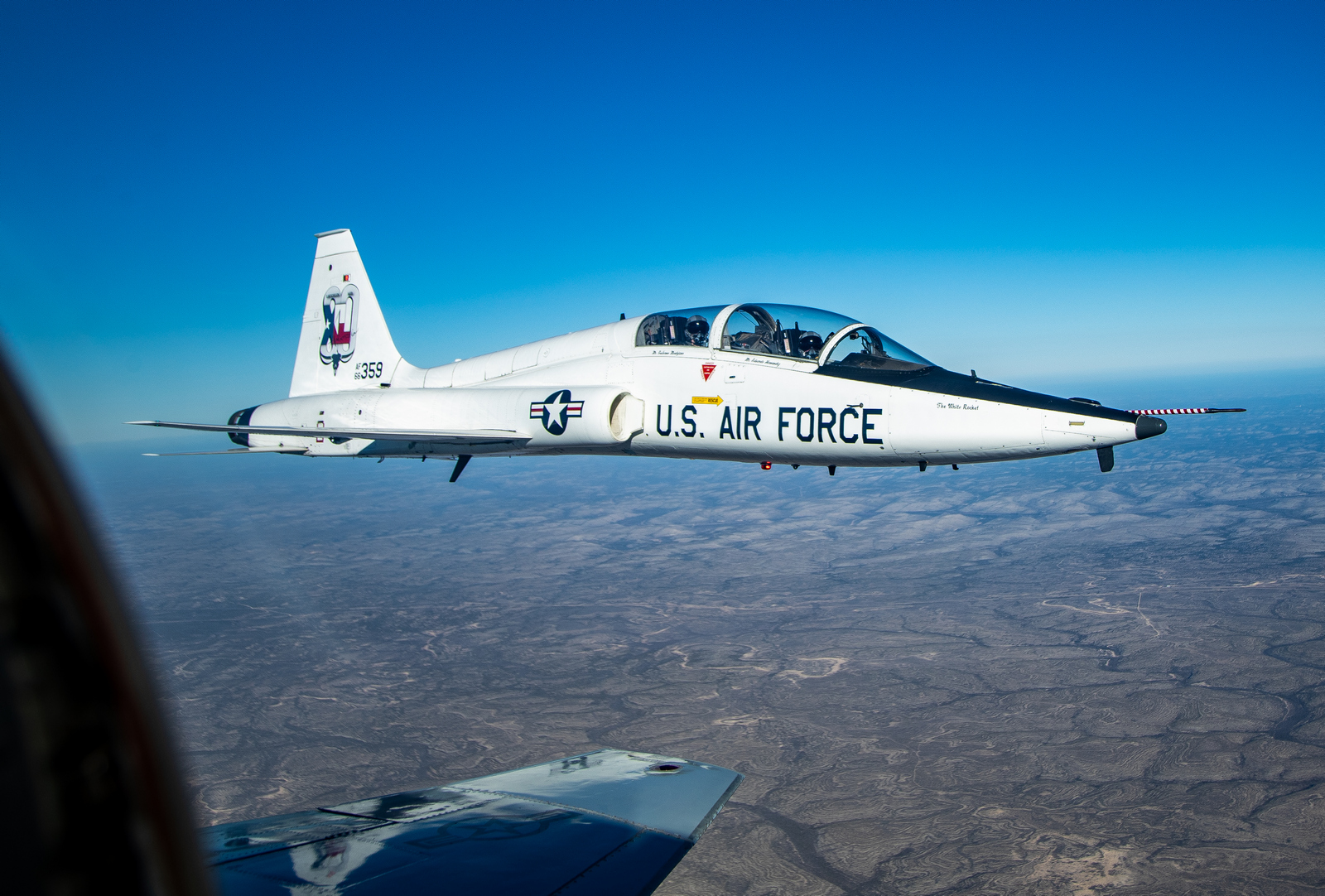
RED BULLS IN XL
65 years of service for the White Rocket
Report and photos by George Karavantos
June 28, 2026
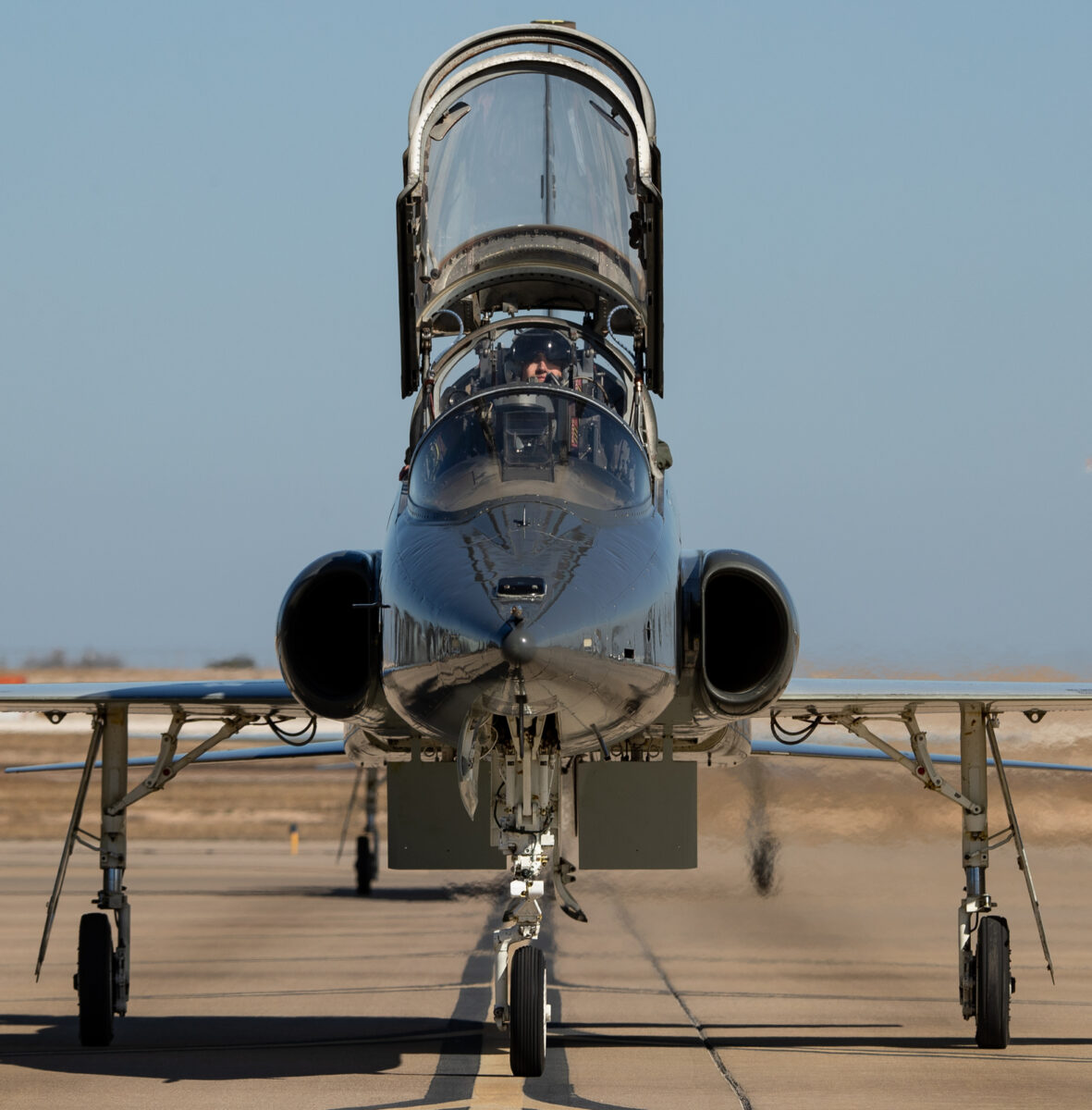
The T-38 Talon is the mainstay trainer of the USAF that first flew on 10 April 1959 and entered service on 17 March 1961, exactly 65 years ago! It was the world’s first supersonic trainer and is also the most produced one. George Karavantos visited Laughlin AFB and 87th FTS to take a closer look to this unique aircraft.
In the mid 50s the Air Force was in the middle of developing the Century Series of jet fighters, beginning with the F-100 Super Sabre and progressing through a line of ever larger, more powerful, and faster aircraft. The lone exception was the lightweight and very powerful F-104 Starfighter. Northrop Aviation, having become aware of the small-but-powerful General Electric J-85 jet engine, decided to go alone and produce a true lightweight fighter propelled by two of these 3,000-pound thrust (with afterburner).
The prototype that emerged, designated N-156, set the design for the more than 2,500 F-5 “Freedom Fighters” that would serve for nearly six decades with air forces around the world. Despite its success as an export fighter, the F-5 didn’t attract any interest from the USAF. However, the design became an immediate contender to replace the aging T-33 Shooting Star (itself a derivative of the original single-seat Lockheed P-80) in the 1958 U.S. Air Force Undergraduate Pilot Training (UPT) advanced trainer competition.
The subsequent airplane, the T-38A Talon, a graceful beauty with stunning performance capabilities (often dubbed the “White Rocket’), became the winner of that competition and secured a huge contract with USAF. The T-38 entered service as the Air Force advanced trainer on 17 March 1961 and continues in that role until today, even as it is being replaced by the Boeing-Saab T-7 Red Hawk. 1,187 examples were constructed between 1961 and 1972.
Looking back 65 years ago to those early T-38A sorties with the 3510th Flying Training Wing at Randolph Air Force Base, Texas, it’s clear how dramatically-different the Talon was compared to the Lockheed T-33 it replaced. In 1962, a T-38A wrested the 3,000-, 6,000-, 9,000-, and 12,000-meter records for absolute time to climb from the significantly more powerful F-104 Starfighter.
Since its introduction, it is estimated that some 50,000 military pilots have trained on this aircraft.
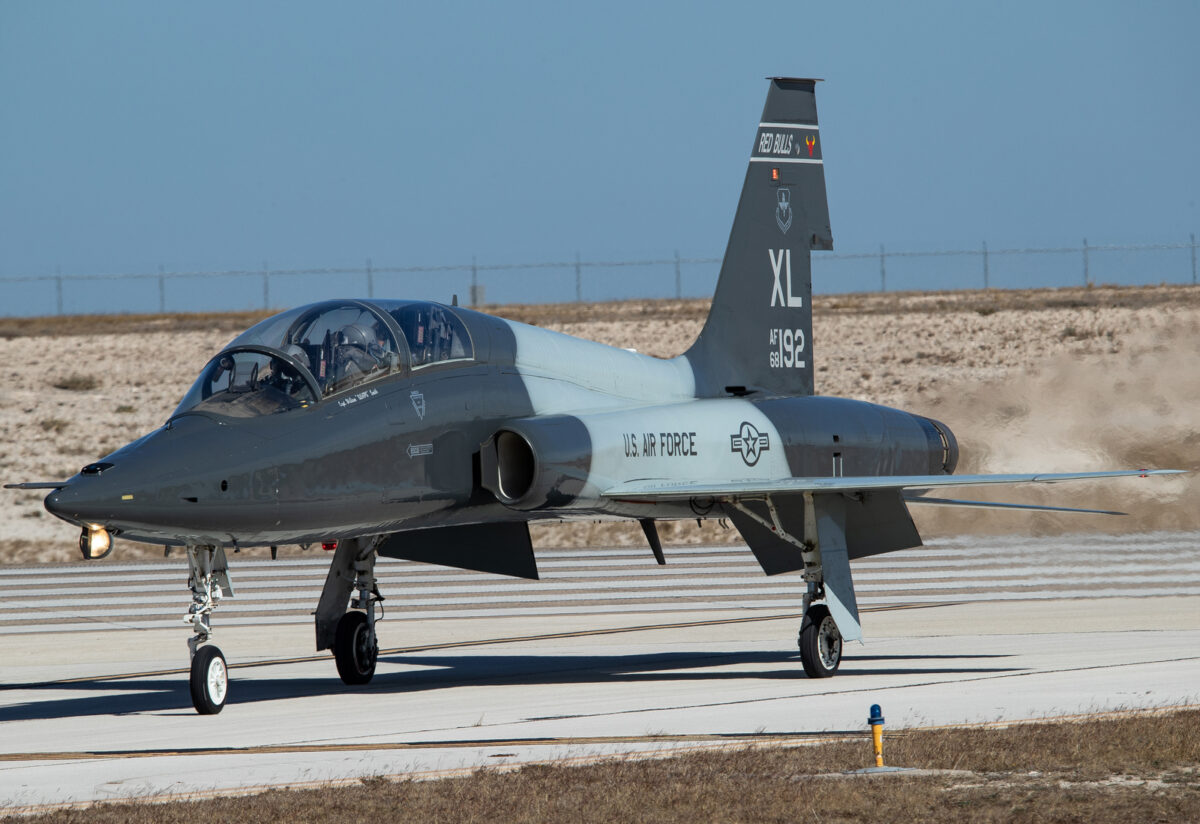
Pilot’s Perspective:
So, this prompts the question: What is it like to fly the T-38? The more than 50,000 pilots who have flown the aircraft would tell you it flies as well as it looks. With the power to perform beautiful, 6,000- feet loops, a 720-degree-per-second roll rate, and 170-knot final approach speed, the airplane responds to the pilot’s slightest commands with immediate response. And hats off to T-38 instructor pilots (IPs). Since the T-38 does not feature the “stadium seating” – the instructor seat mounted well above the student’s – of more modern trainers, T-38 IPs master landing from the back seat without actually being able to see their touchdown point. And landing is the best part – just aim about 500 feet short of the runway threshold, and at the last second, pull back slightly on the stick, and the Talon will smoothly touchdown at the cruise speed of a Cirrus SR20 every time. We had the opportunity to interview one of the 87th’s instructor pilots, Captain Brooks “GHOUL” Alexander, about the pros and cons of flying a T-38.
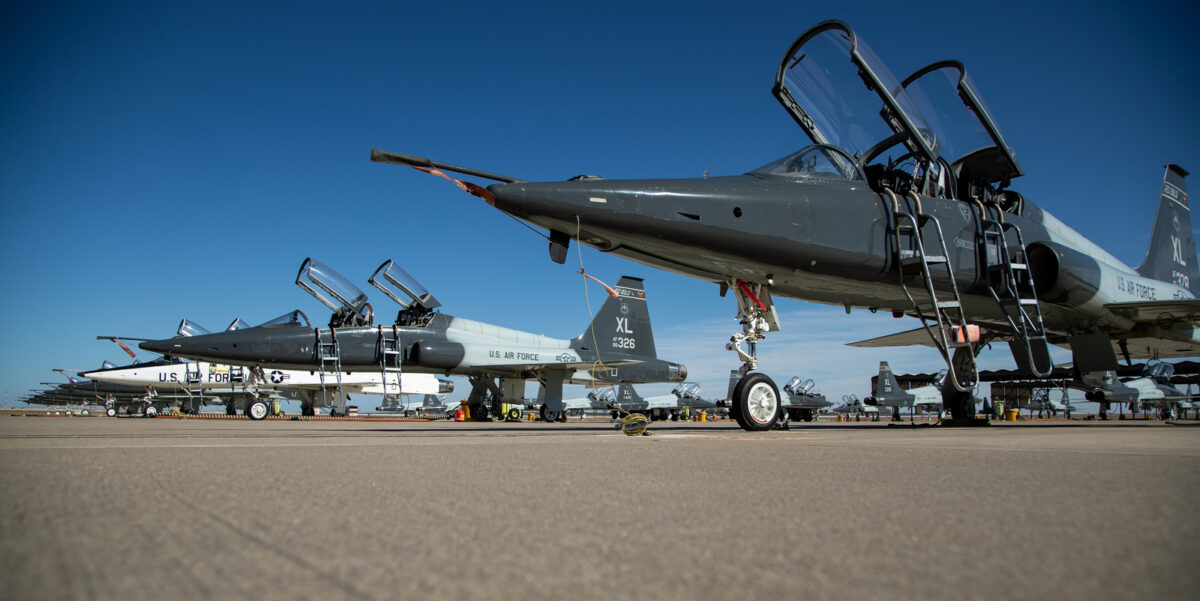
Interview:
– What makes the T-38 still a capable trainer today?
It’s a true “stick and rudder fly by the seat of your pants” aircraft. There’s no fly-by-wire flight controls or auto-flaps like most fast moving aircraft now have. You have to think for the airplane and stay way ahead of it with your decision making. It is also a supersonic trainer, forcing the students to stay ahead of the aircraft and be prepared for their follow on aircraft. Sometimes students have a matter of seconds before their formation is about to exit the assigned airspace, so they have to plan maneuvers out in advance to ensure they will remain within the confines. There are times when the student is flying the jet, programming the flight plan and having to read back clearances to ATC. Without any autopilot or autothrottle. Just a basic flight director. For that reason the flying part has become so “second nature” that by the time you move on to another aircraft, the flying part is something that you don’t focus anymore.
Also the aircraft has received continuous upgrades over its lifecycle. From avionics upgrades with full onboard RNAV capabilities and F-16 style HUD to the PMP upgrade of the early 2000s that enhanced its hot weather / low altitude performance.
– But at the same time what makes it old and outdated?
It’s no secret that the jets are consistently facing maintenance problems. From electrical malfunctions to engine compressor stalls, a lot of wear and tear are put on the airframes in order to be able to fly two or three times a day, up to 7 days a week.
As a trainer, it is pretty susceptible to stalls and is not characterized by a nose dropping with a stall, it just tends to buffet and develop a large sink rate.
Only way to get out of a stall is in afterburner. This can become a very dangerous situation quickly when turning to final. Last but not least portions of the cockpit haven’t changed since the jet entered service in the 60s, so the interior is a mix of many different eras.
– What are the pros and cons of the T-38 for the pilot in terms of flying?
Pros: It is a rocket! When it’s cold outside and you’re in afterburner, unrestricted climbs are incredible. In 1962, a T-38 set the time to climb record, reaching 39,370 in 1 min 35 seconds. The airplane accelerates quickly and can be very challenging to slow down, even with the speed brake extended.
The up-front control panel (UFCP) is intuitive and allows full programming of the radios, flight plan, GPS, and other systems with a few button presses.
Cons: Stalls can be very dangerous if not properly recovered from. There is limited amount of fuel onboard so the fuel planning is always very important. In every flight could be a matter of minutes before you end up in a minimum or even emergency fuel situation.
There is no autopilot or autothrottle, so how well it flies largely depends on how well the jet has been trimmed. It can also be very challenging to land. During no-flap landings, final approach speeds can reach even 190kts and leaves you with very few seconds to pull throttles to idle and time to flare right. This can be the difference between blown tires and a potentially damaged aircraft or a very nice landing.
– What are the challenges of flying this aircraft with a student pilot from the trainer’s perspective?
The students have to learn to fly the aircraft as an aircraft commander, so it is very important to let them make their own decisions and let them fly without any interference. Often the best learning occurs when the instructor lets a situation develop and then debriefs it on the ground with the student, instead of always jumping in early and “saving the day.” It can be very challenging to know how quickly a dangerous situation is developing and whether or not the instructor should jump in and take over.
Of course, the rear cockpit visibility has to be mentioned. You only have a few inches above and on the side of the student to see the runway. During some approaches, the entire runway can be hidden by the front cockpit’s canopy bow until a 1/4 mile final from the runway. If flying an instrument approach and breaking out of the weather, this means you only have seconds to find your aim point and land successfully.
– What stages/phases of training in the USAF does the 87th and T-38 cover?
After students graduate from the T-6A “Texan II” program and receive their wings, a portion of them is selected to fly the T-38C with the 87th Flying Training Squadron. The T-38C syllabus prepares them for a fighter or bomber aircraft assignment.
– How are Laughlin AFB and USAF preparing (in terms of training syllabus and procedures or even equipment) for the transition from the T-38 to the T-7?
After the retirement of the T-1A “Jayhawk,” the 87th FTS gained the opportunity to renovate and move into the T-1 facility which is quite spacious and is significantly newer than the “Red Bulls” previous building. Every flight room and briefing room has been outfitted with new technology and is set up to work well for many years to come. New sun shades have been installed on the flight line for parking the T-7A so that maintenance and aircrew can stay cooler in the summer months when temperatures exceed 100 degrees F.
Randolph AFB has received the first two T-7As and will be working on a syllabus and new procedures in the coming months. The T-7A has many advantages over the T-38 and will be an incredible leap in technology and performance.
Personal details:
Captain Brooks “GHOUL” Alexander, commissioned from Air Force ROTC Detachment 075 in San Diego, CA. Born and raised in the Dallas/Fort Worth, TX area. Great-grandfather was a captain and in the USAAF and flew B-24 “Liberator” bombers during WWII. He has around 550hrs in the T-38C and he is also an RSU (runway supervisory unit) controller. The RSU controls the T-38 runway and traffic pattern during times of high traffic density and specifically when students are flying solo.
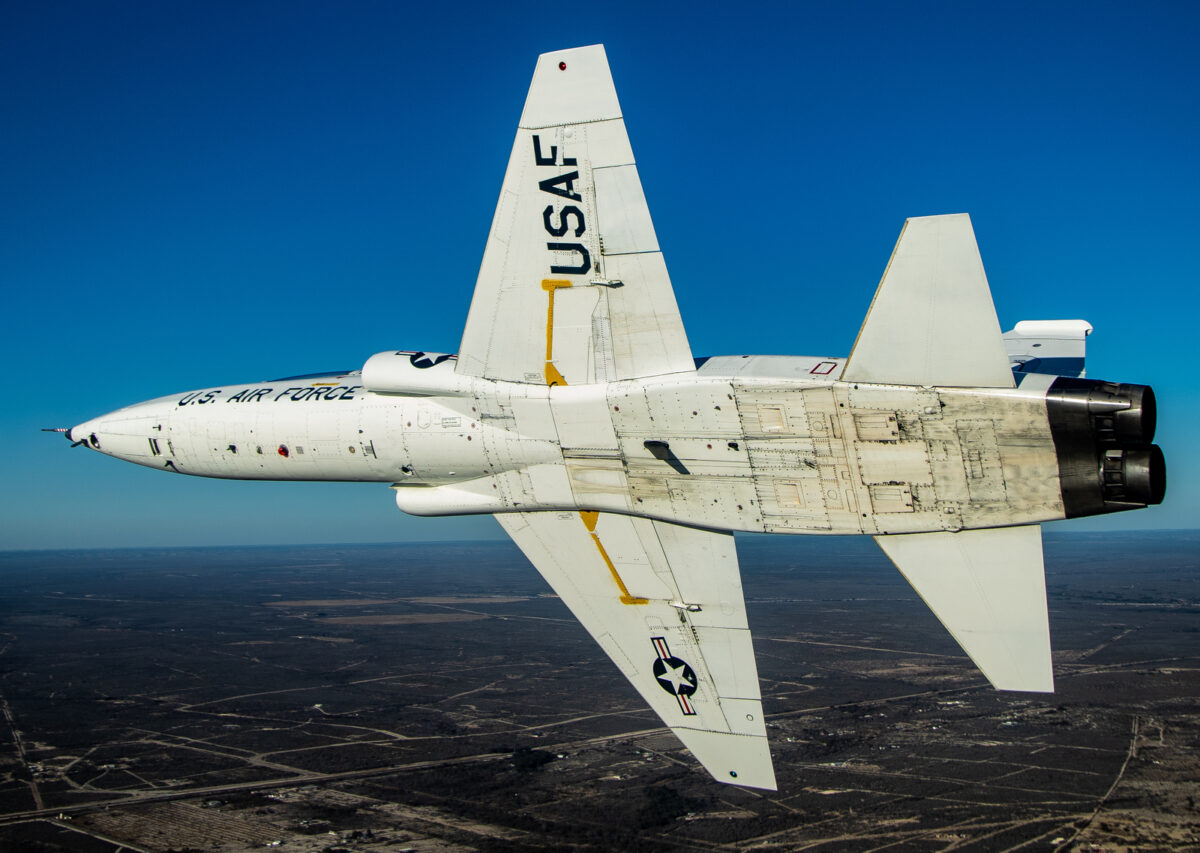
87th History:
The squadron was designated as the 87th Aero Squadron and established on 18 August 1917. Active time was very short as the unit was redesignated Squadron B, Park Field, on 25 July 1918.
The unit was reconstituted and consolidated with the 87th Pursuit Squadron on 1 December 1936. The combined unit was then demobilized on 1 January 1938.
The lineage continued when the unit was constituted as the 87th Pursuit Squadron (Interceptor) on 13 January 1942 and activated on 9 February at Dale Mabry Field, Florida. After activation the unit was redesignated the 87th Fighter Squadron on 15 May 1942 and was stationed at Morris Field, North Carolina. During this period the squadron was flying P-40 Warhawk aircraft and soon transferred to the North African Campaign to fly against Rommel’s Corps.
In 1944 the 87th converted to the P-47 Thunderbolt and pressed the Axis forces up the Italian peninsula following their dynamic support at the invasions of Sicily and Anzio. The end of World War II found the 87th moving from Southern France to Austria where deactivation occurred on 15 July 1947.
On 1 November 1952, the 87th was reactivated and served at Sioux City, Iowa, flying the P-51 Mustang, transitioning to their first jet aircraft, the F-86D Sabre in 1953. In December 1954, the 87th moved to Bentwaters, England, and deactivated in September 1955.
In 1956, the 87th was reactivated as a part of the Aerospace Defence Command at Lockborne Air Force Base, Ohio, still flying the F-86D Sabre. While still at Lockborne Air Force Base, the 87th was reequipped with the F-102 Delta Dagger in 1958 and continued to fulfill its alert commitment. In 1960, the F-101 Voodoo became the primary aircraft of the squadron until deactivation in June 1968.
Actual deactivation was short-lived as the 11th FIS at Duluth IAP, Minnesota, was redesignated the 87th FIS in October 1969, and the front line of defense became the F-106 Delta Dart. A new and varied mission filled the 87th Fighter Interceptor Squadron operational role as a worldwide deployment capability expanded its horizons. The 87th utilized air refueling capabilities and the much greater range of the F-106 to fulfill alert commitments in the Alaska Region. It was at this time that the squadron adopted the “Red Bull’ mascot and the squadron’s aircraft had a distinctive red bull’s head painted on the tail flash.
In May 1971 the 87th moved to K. I. Sawyer AFB, Michigan, where it maintained readiness in all-weather intercept techniques, aerial refueling, and fighter-vs-fighter tactics. The 87th was scheduled to convert to the F-15 Eagle in 1984. Due to budget cuts the conversion was cancelled and the squadron again scheduled for inactivation on 1 October 1985.
The 87th was redesignated the 87th Flying Training Squadron and activated on 2 April 1990 at Laughlin Air Force Base, Texas, flying the T-38A Talon advanced supersonic trainer. On 4 October 2006, the squadron received its first T-38C. Nowadays it has a fleet of 57 aircraft and graduated 106 pilots, flew 9.383 sorties, logging 10.489 hours last fiscal year.
EPILOGUE:
Despite its age, the Northrop T-38 Talon continues to serve with distinction. While newer trainer aircraft are emerging, the T-38’s proven track record, cost-effectiveness and ongoing modernization efforts ensure its continued relevance for years to come. It remains an indispensable tool for preparing the next generation of aviators, offering them the fundamental skills and discipline required for modern aerial combat and complex flight operations.
Its legacy is not just in the numbers of pilots it has trained or the missions it has flown, but in the enduring spirit of innovation and dedication it represents. The T-38 Talon is more than just a jet trainer, it is a symbol of aviation excellence, a silent mentor to countless aspiring pilots and a testament to the timeless pursuit of mastery in the skies. As it continues to soar, the Talon reminds us that true innovation and robust design can stand the test of time, leaving an indelible mark in the history of flight. Long live the Talon!
The author would like to thank the PA department, the Commander and IPs of Laughlin AFB who made this flight a reality.


George Karavantos is from Athens, Greece. His love with military aviation started at the age of 10 when he accidentally read a Greek aviation magazine. Since then, he never stopped reading about fighter aircraft and taking photos of them. He was too tall to become a fighter pilot, so he became an airline pilot. Nowadays he is a Captain and a Flight Instructor on the A320 aircraft. Despite his profession, military aviation will always be his obsession.