
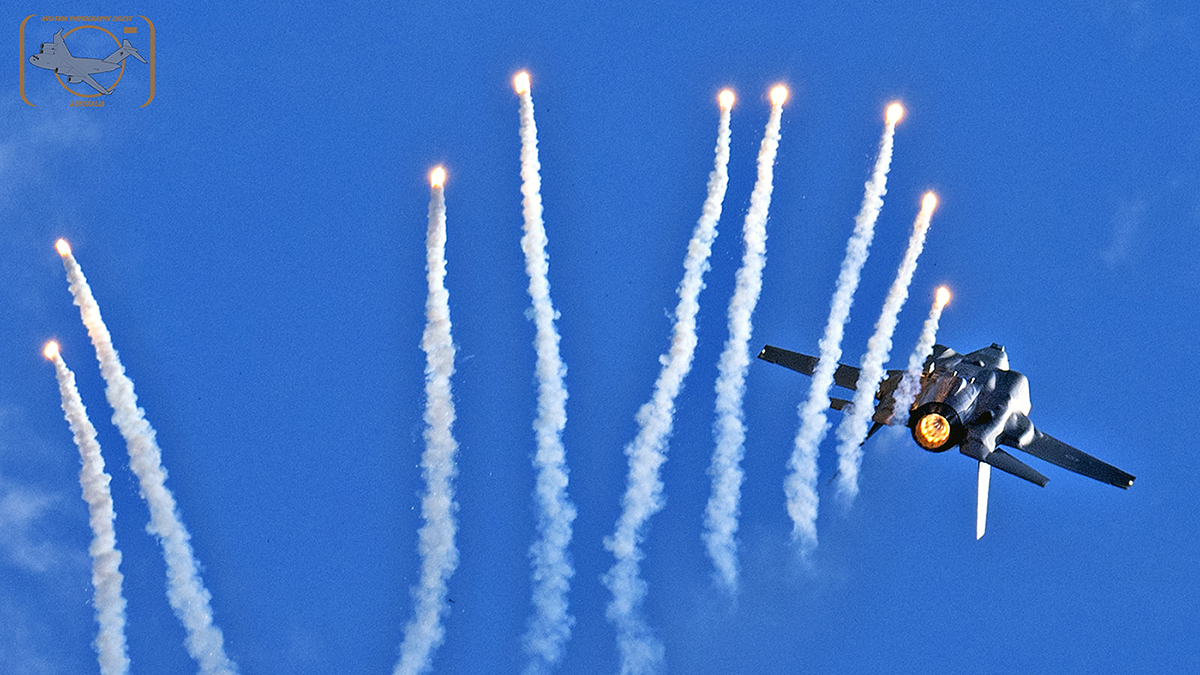
RAAF F-35 achieve Full Operating Capability.
Royal Australian Air Force has declared Full Operating Capability for its fleet of F-35A Lightning II aircraft.
ARTICLE & IMAGERY: Jaryd Stock
Royal Australian Air Force (RAAF) has declared final (full) operational capability for its fleet of Lockheed Martin F-35A Lightning II aircraft at a Australian Government Senate estimates inquiry held in early December.
First announced by the then John Howard led Liberal government approved project AIR 6000 Phase 2A/2B back in June of 2002 and announced that it would intend ti buy into the the then known Joint Strike Fighter program to replace the RAAF’s aging F/A-18A/B “Classic Hornet” fleet of aircraft based at Williamtown and Tindal, and the fleet of F-111C/G “Pig” aircraft based at Amberley.
The final number of F-35 aircraft purchased was whittled down from 100 to 72, and were to subsequently replace the classic hornets with RAAF 81 Wing as F/A-18F Super Hornets having been announced ti replace the much loved “Pig” in 2007 and delivered in 2009. The offical order for the F-35 was given in 2006.
The first flight of Australia’s very first F-35 AU-1 occurring during September 2014 when the aircraft conducted a 2 hour test flight from Lockheed Martins production facility located in Fort Worth Texas in 2014.
The first batch of deliveries began in 2018 when two F-35’s arrived with much fanfare into RAAF Base Williamtown flown by then commanding officer of No.3 Squadron Darren Claire and Squadron Leader Red Borrman after completing a Trans-Pacific flight from the United States.
The final 9 of the 72 jets arrived in Australia arrived at RAAF Base Williamtown in New South Wales in December of 2024.
The last 9 aircraft were brought up to the Block 4 standard which were apart of the Technology Refresh-3 updates undertaken by RAAF which give the RAAF F-35’s significant enhancements more powerful processes and situational awareness for pilots.
Block 4 system upgrades also include the new Northrop Grumman built AN/APG-85 AESA radar system providing enhanced electronic warfare, jamming resistance, and multi-function sensing for superior battle-space awareness, giving greater awareness to current threats as well as those emerging in the future.
Also included in the Block 4 upgrades is Distributed Aperture System which is an advanced sensor network making the F-35 a sensor node for full 360-degree spherical awareness, providing pilots with missile detection, tracking, and autonomous threat identification.
At the senate estimates hearing the Australian Defence Force Chief of Defence Force (CDF) Admiral David Johnston stated that now the F-35 fleet had be delivered to the RAAF that flying hours on the F-35 would start to stabilise as now the aircraft has been delivered that the full fleet of aircraft is now at the airforce’s disposal when called upon.
Chief of Air Force Air Marshall Stephen Chappell stated at the inquiry that the fleet of RAAF “F-35 aircraft has amassed 79,000 hours of flying” since being introduced to service. The entire F-35 program’s fleet of aircraft in use with several allied airforces has surpassed 1 million flight hours in March 2025, showing significant overall usage.
The RAAF F-35 Lightning II aircraft achieving Final Operating Capability is a significant milestone for the program here in Australia, and is supported by Defence, Lockheed Martin and BAe Australia (British Aerospace Australia) which is located at RAAF Base Williamtown with a workforce of around 340 personnel supporting F-35 Lightning and Hawk Mk.127 maintenance programs with 12 maintenance bays currently being constructed and delivered next year (2026) at the BAe facility at Williamtown.
CDF Admiral Johnston stated that the F-35 fleet of aircraft achieved FOC on Jul 7th 2025. Why that significant milestone was not announced at that time is not known but is following a pattern set by the Australian Defence Force of not disclosing that information to the public or to media, but do not read too much into that as the Defence Australia and RAAF media teams are just now in December posting image updates from July of this year on their social media channels.
Moving forward RAAF 81 Wing which operates the F-35 fleet now looks at whats next for the fighter jet, with that fleet the RAAF’s goal is to maximise the systems and ways the aircraft is operated and to extract efficiency from the global supply chain, as the aircraft is expected to be within RAAF service until the mid 2060’s.
New weapons will be introduced on the aircraft with the The Lockheed Martin AGM-158C Long-Range Anti-Ship Missile (LRASM), to be integrated on the F-35 as well as the afore mentioned F/A-18F Super Hornet (first RAAF tests took place earlier this year off the coast of California- you can read our interview with CO 1SQN about those tests from earlier in the year found on this website).
The LRASM changes the scope on maritime strike as it is entirely passive as well as being stealthy, integrating target data from a radio-frequency seeker, an imaging infra-red sensor and datalink to identify and acquire a specific target and select its impact point.
Another potential is the introduction into service of the the Lockheed Martin AIM-260 Joint Advanced Tactical Missile (JATM) which the United States clearing Australia to be a export customer earlier this year. The AIM-260 looks to replace the AIM-120 AMRAAM missile, it is a long-range air-to-air missile developed with a range rumoured to be double that of the AIM-120.
So although the RAAF have declared FOC for the F-35 fleet, over the coming decades there still will be ongoing operational test and evaluation processes to integrate new weapons and systems to keep the fleet at the top of the food chain in contested air environment.


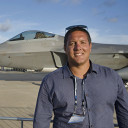
Jaryd Stock is based in Sydney Australia. He has been a die-hard aviation enthusiast from a young age when he was chauffeured around by his father to various airshows and airports around Australia. At his first Airshow he witnessed the awesomeness of a General Dynamics F-111C and immediately fell in love with aviation.
Jaryd picked up a camera at a young age and has never looked back. He now combines photography and writing to highlight “Downunder” aviation; especially U.S. DoD units. Jaryd uses Nikon cameras and lenses.