

Australia commits to the MQ-28A
Ghost Bat.
Australian Government commits to a third tranche of MQ-28 Ghost Bat Collaborative Combat Aircraft.
Article: Jaryd Stock
Images: RAAF/ Boeing
The Australian Government has awarded Boeing Defence Australia an AUD$754 million contract to deliver, develop and support a third tranche of MQ-28 Ghost Bats over the next three years.
Under the AIR6015 Autonomous Collaborative Platforms – Air Program, Boeing will deliver additional Block 2 and Block 3 aircraft to support the development of an operational capability by 2028. It will also progress delivery of the capability system and supporting infrastructure for the Royal Australian Air Force to supplement existing crewed fleet with integrated Collaborative Combat Aircraft (CCA).
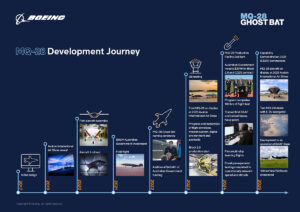
The Program of Record follows the completion of a successful development program, with eight MQ-28 Ghost Bats and multiple highly capable mission payload modules produced, and a further three Block 2 in final production or testing phases.
-Boeing
“MQ-28 is the most mature CCA program in allied nations, and this latest investment by the Australian Government provides for the development of the next generation of CCA technology and the delivery of an operational capability for Australia,” said Amy List, Boeing Defence Australia managing director.
“We’ve already implemented an accelerated capability and successfully proved how the MQ-28 fits into the force mix.
“This agreement further cements our MQ-28 partnership with the Royal Australian Air Force and Australian industry through to 2028,” List said.
The announcement was made at a press briefing in Sydney in which APD was not invited to due to Defence Australia’s bizarre media engagement rules, coincided with a historic achievement undertaken by Boeing and the Royal Australian Air Force (RAAF) at Woomera having successfully executed a force integrated air-to-air autonomous weapon engagement from an MQ-28 Collaborative Combat Aircraft.
Earlier this year at the Avalon Airshow held back in March RAAF Chief of Air Force Air Marshall Stephen Chappell stated that a weapons test was scheduled for either end of 2025 or early 2026.
The landmark mission involved an MQ-28 Ghost Bat teaming with a RAAF E-7A Wedgetail from No.2 Squadron and a F/A-18F Super Hornet from No.1 Squadron to destroy a fighter-class target drone.
“This is the first time an autonomous aircraft has completed an air-to-air weapon engagement with an AIM-120 missile, establishing the MQ-28 as a mature combat capable CCA,” said Amy List, managing director, Boeing Defence Australia.
“This latest achievement proves the advantage specialized CCA platforms bring to defense forces’ mission effectiveness, delivering increased operational mass and data exchange for informed decision-making while reducing cost and crewed pilot risk.”
Key mission highlights:
- The MQ-28, E-7A and F/A-18F launched from separate locations.
- Once airborne, an E-7A operator took custodianship of the MQ-28 ensuring safety and engagement oversight.
- The F/A-18F teamed with the MQ-28 in combat formation to provide sensor coverage, and once the Super Hornet identified and tracked the target, targeting data was shared across all three platforms.
- The MQ-28 adjusted its position and received authorization from the E-7A to engage and successfully destroy the target using a Raytheon AIM-120 AMRAAM missile.

An AIM-120 Advanced Medium Range Air-to-Air Missile is launched from an MQ-28A Ghost Bat during Trial Kareela at RAAF Base Woomera, South Australia.- RAAF
“This exercise demonstrates the maturity and sophistication of Boeing’s mission autonomy solution which is built on open standards and government architectures and is capable of integrating with fourth, fifth and sixth generation aircraft,” said Colin Miller, vice president and general manager for Phantom Works, Boeing Defense, Space & Security’s advanced research, development and rapid prototyping division.
“It is a true example of speed-to-capability. The team implemented open architectures and an advanced digital ecosystem to develop the necessary hardware, software, and mission systems required to successfully integrate, test and employ the weapon in a live, operationally relevant scenario in under eight months.”
The exercise was a collaborative effort between Boeing, the RAAF, U.S. Air Force and industry partners.
Reflecting on the success of the Ghost Bats first live fire exercise RAAF Wing Commander Phillip Parsons, Detachment Commander Combined Experimental Operation Flight, said the trial was significant for two reasons.
“It proves that the MQ-28A is a world-leading CCA capability, and it demonstrates that the project is on time, and importantly, on target,” Wing Commander Parsons said.
“The combined team took the concept of a weapon shot from idea to execution in just nine months.”
The MQ-28 was a first-of-its-kind collaboration between the RAAF, Defence Science and Technology Group and Boeing Australia. The Australian Government has invested over AUD$1 billion to date, with 70% of expenditure contributed to the 200+ Australian industry team.
Interesting from allied nations has gained momentum recently with a few taking a keen interest in the development of the CCA.
Jaryd Stock is based in Sydney Australia. He has been a die-hard aviation enthusiast from a young age when he was chauffeured around by his father to various airshows and airports around Australia. At his first Airshow he witnessed the awesomeness of a General Dynamics F-111C and immediately fell in love with aviation.
Jaryd picked up a camera at a young age and has never looked back. He now combines photography and writing to highlight “Downunder” aviation; especially U.S. DoD units. Jaryd uses Nikon cameras and lenses.